Understanding Digital Scarcity
"Why Bitcoin's fixed supply matters in a world of fiat currency expansion."
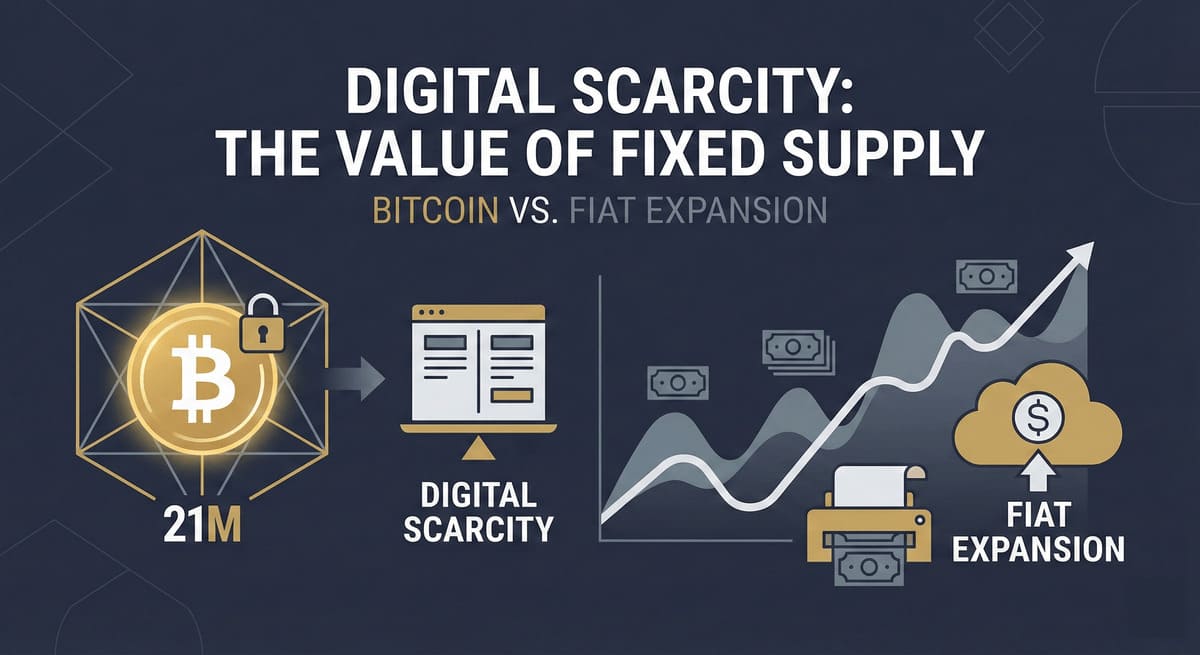
I used to think scarcity was something you could only find in the physical world. Gold is scarce because you have to dig it out of the ground.
Real estate is scarce because they’re not making any more land. Diamonds are scarce because they take millions of years to form.
But digital things? In my mind, anything digital could be copied. A file, a photo, a song all of it could be duplicated infinitely. How could something on a computer screen ever be truly “scarce”?
Then I learned about Bitcoin, and it completely changed how I think about digital value.
(Disclaimer: I am sharing my personal research and understanding. This is not financial advice. Always do your own research.)
The Problem with Digital Things
Before Bitcoin, if you had a digital file, you could copy it. If I sent you a PDF, I still had the original. If you shared a song with a friend, you both had it. There was no way to make something digital truly “one of a kind.”
This is why, for decades, people laughed at the idea of “digital money.” How can you have digital cash if anyone can just copy-paste it and create unlimited versions?
Nakamoto solved this problem. In 2008, the anonymous creator(s) of Bitcoin published a whitepaper that introduced a way to create digital scarcity for the first time in history.
What is Digital Scarcity?

Digital scarcity means there is a fixed, limited supply of a digital asset that cannot be increased, copied, or forged.
Bitcoin is the first successful implementation of this concept. There will only ever be 21 million Bitcoin. This number is hard-coded into the protocol and enforced by a decentralized network of computers (called “nodes”) around the world.
No government can print more. No CEO can decide to change the limit. No hacker can create fake Bitcoin out of thin air.
Why This Matters in Today’s World
I started paying closer attention to this concept when I looked at what’s happening with traditional currencies.
In 2020 alone, the US Federal Reserve printed approximately $3 trillion in new money about 20% of all US dollars in existence were created in that single year. This wasn’t unique to America; central banks worldwide followed similar paths.
When you increase the supply of something, each unit becomes worth less. It’s basic economics. If you have 100 rare baseball cards and someone finds a warehouse with 10,000 more, your cards suddenly aren’t so rare anymore.
This is where Bitcoin’s scarcity becomes relevant.
“Bitcoin is the first example of a digital asset which is scarce, like gold or diamonds.” Hal Finney, early Bitcoin pioneer and the first person to receive a Bitcoin transaction
The Mathematical Certainty
What fascinated me most was the predictability. With fiat currency, we don’t know how much will be printed next year. Politicians change, policies shift, crises happen and suddenly trillions appear.
With Bitcoin, we know exactly what the supply will be:
- Today: Approximately 19.5 million Bitcoin exist
- In 2030: We can calculate the exact supply
- In 2140: The last Bitcoin will be mined, reaching the 21 million cap
This isn’t a guess or a promise. It’s mathematics enforced by code.
How Does This Compare to Gold?
I often hear the comparison: “But gold is also scarce!”
True, but there’s a difference. Gold is scarce, but not fixed. Mining companies discover new gold deposits.
Technology improves, making it easier to extract gold from places that were once impossible to reach. According to the World Gold Council, approximately 3,000 tonnes of gold are mined each year, adding to the existing supply.
Bitcoin is different. The supply is not just “scarce” it is mathematically capped. No matter how much someone wants to mine more Bitcoin, they cannot exceed the 21 million limit.
Who Recognizes This Value?
When I researched further, I found that some of the world’s most sophisticated investors had already reached the same conclusion.
Paul Tudor Jones, the legendary hedge fund manager, wrote in a 2020 investor letter: “Bitcoin serves a very useful role as a store of value… it has the highest risk-adjusted return of any asset class in history.”
Michael Saylor, CEO of MicroStrategy, moved billions of corporate treasury into Bitcoin, calling it “the world’s best collateral.”
Even traditional financial institutions like Fidelity and BlackRock have acknowledged Bitcoin’s unique properties as a scarce digital asset.
Conclusion
Understanding digital scarcity was my “lightbulb moment.” It wasn’t about whether I liked the technology or understood all the technical details. It was about recognizing a fundamental shift in what’s possible.
For the first time in human history, we have something digital that cannot be copied. Something with a fixed supply that no authority can alter. Whether that holds value is for the market to decide, but the innovation itself is undeniable.
If you’re still wrapping your head around this, you’re not alone. I was skeptical for a long time too. But once I understood scarcity, the rest started falling into place.
Common Questions
Q: What happens when all 21 million Bitcoin are mined? A: Miners will continue to earn money through transaction fees instead of new Bitcoin rewards. The network continues to function the same way.
Q: Can the 21 million cap ever be changed? A: Technically, yesif 51% of the network agreed to change the code. But practically, this would destroy Bitcoin’s value proposition. Every node operator would need to voluntarily upgrade their software. The economic incentive is to keep the cap intact.
Q: Is scarcity alone enough to give Bitcoin value? A: No. Scarcity is one property. Value also comes from utility, network effects, security, and adoption. But scarcity is the foundation that makes all other properties meaningful.
References
- Nakamoto, S. (2008). Bitcoin: A Peer-to-Peer Electronic Cash System. https://bitcoin.org/bitcoin.pdf
- World Gold Council. (2024). Gold Mining Production Data. https://www.gold.org/goldhub/data/historical-mine-production
- Federal Reserve. (2020). Money Stock Measures.
- Jones, P.T. (2020). Macro Outlook – The Great Monetary Inflation.