The Rule of 72: The Simplest Math Trick That Changed How I Think About Money
"You don't need a finance degree to understand compound interest. One simple formula, this rule can show you exactly how fast your money grows."
I used to think investing was only for people who understood spreadsheets, economic reports, and complicated charts.
Then I discovered a rule so simple, you can calculate it in your head. No spreadsheet. No calculator. Just one number and it changed how I see every dollar I save.
It’s called the Rule of 72.
(Disclaimer: I am sharing my personal experience and research. This is not financial advice. Always do your own research before making any financial decisions.)
What Is the Rule of 72?
Here’s the rule in one sentence:
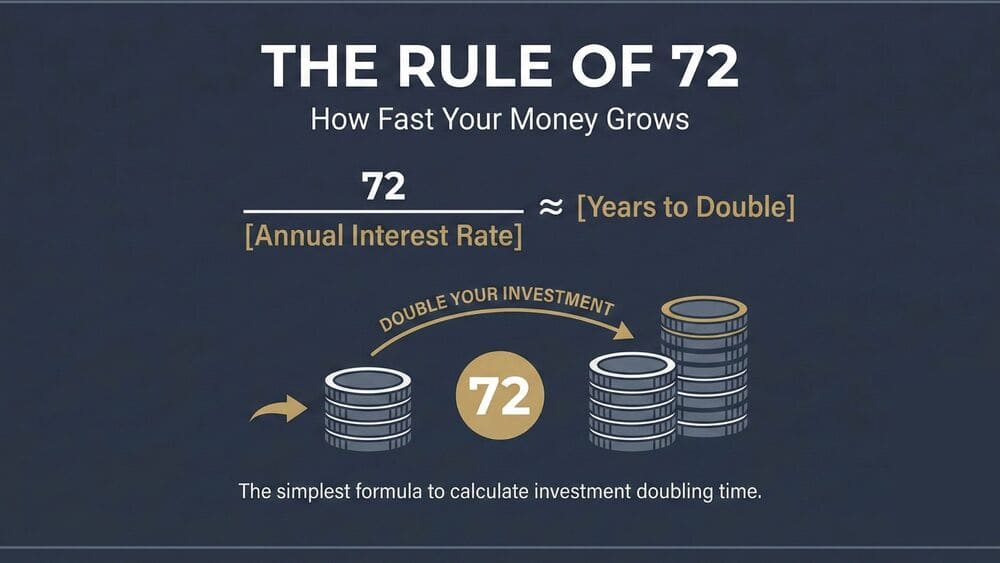
Divide 72 by your annual interest rate, and you’ll know how many years it takes for your money to double.
That’s it. That’s the whole rule.
Let’s say your savings account gives you a 6% return per year. You divide 72 ÷ 6 = 12 years. Your money doubles in 12 years without you doing anything extra.
It sounds almost too simple to be useful. But the moment you start applying it to real numbers, everything changes.
Why This Rule Matters More Than You Think
Most people know they “should” invest. But few people actually feel it that emotional click when numbers become real.
The Rule of 72 creates that click.
Let me show you two people. Same age, same starting point, very different outcomes.
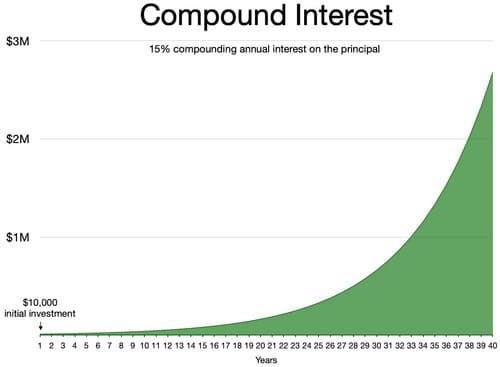
Person A puts $10,000 into a savings account earning 2% per year. Rule of 72: 72 ÷ 2 = 36 years to double. After 36 years, they have $20,000.
Person B puts $10,000 into an index fund averaging 8% per year. Rule of 72: 72 ÷ 8 = 9 years to double. After 36 years, their money has doubled four times turning into roughly $160,000.
Same starting amount. Same time. Completely different result just because of where the money was placed.
The Hidden Cost of Doing Nothing
Here’s where it gets personal for me.
For years, I kept my savings in a low-interest bank account. I thought I was being “safe.” I wasn’t losing money, so I felt fine.
But the Rule of 72 showed me the truth. At 1% interest, my money would take 72 years to double. I would be long retired or worse before I saw any meaningful growth.
That’s not safety. That’s slow erosion disguised as comfort.
The real risk, I learned, wasn’t losing money in the market. It was never letting my money work for me at all.
How to Use the Rule of 72 in Real Life
You can apply this rule to almost any financial decision. Here are three practical ways:
1. Compare investment options Got two options with different interest rates? Use 72 to quickly see which one doubles your money faster. No spreadsheet needed.
2. Understand inflation’s damage Inflation works in reverse it erodes your purchasing power over time. At 4% inflation, the price of things doubles every 18 years (72 ÷ 4). That means your cash sitting idle is quietly losing half its value every 18 years.
3. Set realistic expectations If you’re expecting 10% returns from an investment, you now know your money doubles every 7.2 years. This keeps your expectations grounded and helps you spot promises that are too good to be true.
The Bigger Lesson Behind the Math
The Rule of 72 is not just about numbers. It’s about time.
The earlier you start, the more times your money gets to double. That’s the true power of compound interest and why financial advisors always say “start early.”
Even small amounts, invested consistently at a decent rate, can grow into something significant. Not because you got lucky. But because math is on your side.
You don’t need to be wealthy to start. You just need to start.
Conclusion
The Rule of 72 gave me something rare in personal finance: clarity without complexity.
It helped me stop seeing investing as a game for experts and start seeing it as a tool that anyone can use. Including me. Including you.
Here’s what I want you to take away:
- Time is your biggest asset. The sooner you invest, the more times your money doubles.
- Where you keep your money matters. A 2% account and an 8% account are not the same. The Rule of 72 makes that difference impossible to ignore.
- You don’t need to be an expert. One simple rule can guide smarter decisions and that’s more than enough to get started.
Start with what you have. Let time do the rest.
Common Questions
Q: Is the Rule of 72 perfectly accurate? A: It’s an approximation, not an exact formula. It works best for interest rates between 6% and 10%. For very high or very low rates, the result may be slightly off but it’s close enough for everyday planning.
Q: What if my investment doesn’t have a fixed interest rate? A: Use the average annual return. For example, the S&P 500 has historically averaged around 8–10% per year over the long term. You can use 8% as a conservative estimate.
Q: Can I use the Rule of 72 for debt too? A: Absolutely and this is where it gets sobering. If you have a credit card charging 18% interest, your debt doubles in just 4 years (72 ÷ 18). This rule works both ways.
Q: How much do I need to start investing? A: Less than you think. Many platforms allow you to start with as little as $10 or $50. The amount matters less than the habit of starting.
Q: Is this relevant to me if I’m in Singapore or Asia? A: Yes. The math is universal. Whether you’re investing in SGD, USD, or any other currency, compound interest works the same way. The key is finding investment vehicles with decent long-term returns like ETFs, index funds, or even certain savings plans.
References
- Albert Einstein (attributed). On Compound Interest. Widely cited in financial literature.
- Investopedia. Rule of 72 Definition. Investopedia. 2025.
- S&P Dow Jones Indices. S&P 500 Historical Returns. SPGI. 2025.
- MAS (Monetary Authority of Singapore). MoneySense: Growing Your Money. Singapore Government. 2025.
- Gemini. Bitcoin ETFs in Singapore: What Investors Should Know. Gemini. 2025.